Saturday, March 19, 2022

Goodbye St. Helena

This post was originally made with the satellite connection and email but has been updated with pictures.

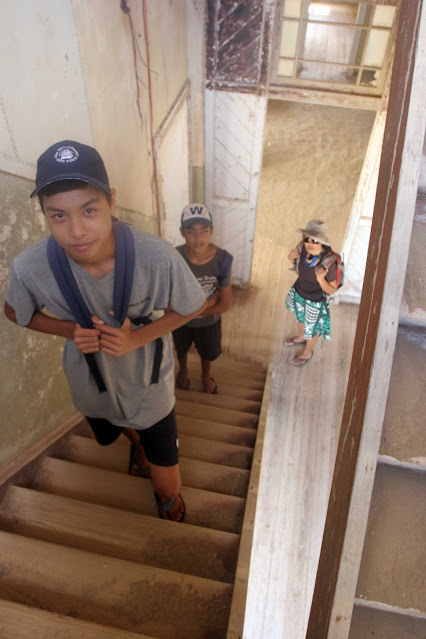
Jacob's Ladder (699 steps)
 

After just over a week in St. Helena, we are continuing on our journey across the Atlantic. St. Helena is not big but is packed with unique and varied terrain (hills and valleys plunging into crystal clear waters, arid scrub, and pastures from an English countryside), as well as loads of history. 

Napolean's house/museum

We visited the house where Napolean spent his final days and used Internet in the remains of an old castle. There are cannons everywhere. The people are friendly and welcoming. Every passing car (and there are a lot of cars) and pedestrian waves and greets every other car and person.

Napolean's tomb (his body has been moved to France)

It's one of the more expensive places we have been, which is understandable considering how remote it is. We will also not miss the anchorage because it can get quite rolly. The trade-off is that we have seen huge Mahi Mahi and Devil rays swimming by the boat. Apparently, a whale shark swam right by our boat in the anchorage but we were busy fixing something and didn't notice.

Sandy Beach


We plan to head to Fernando de Noronha, which is part of Brazil, for a short respite. You can see our progress at https://forecast.predictwind.com/tracking/display/Perry.


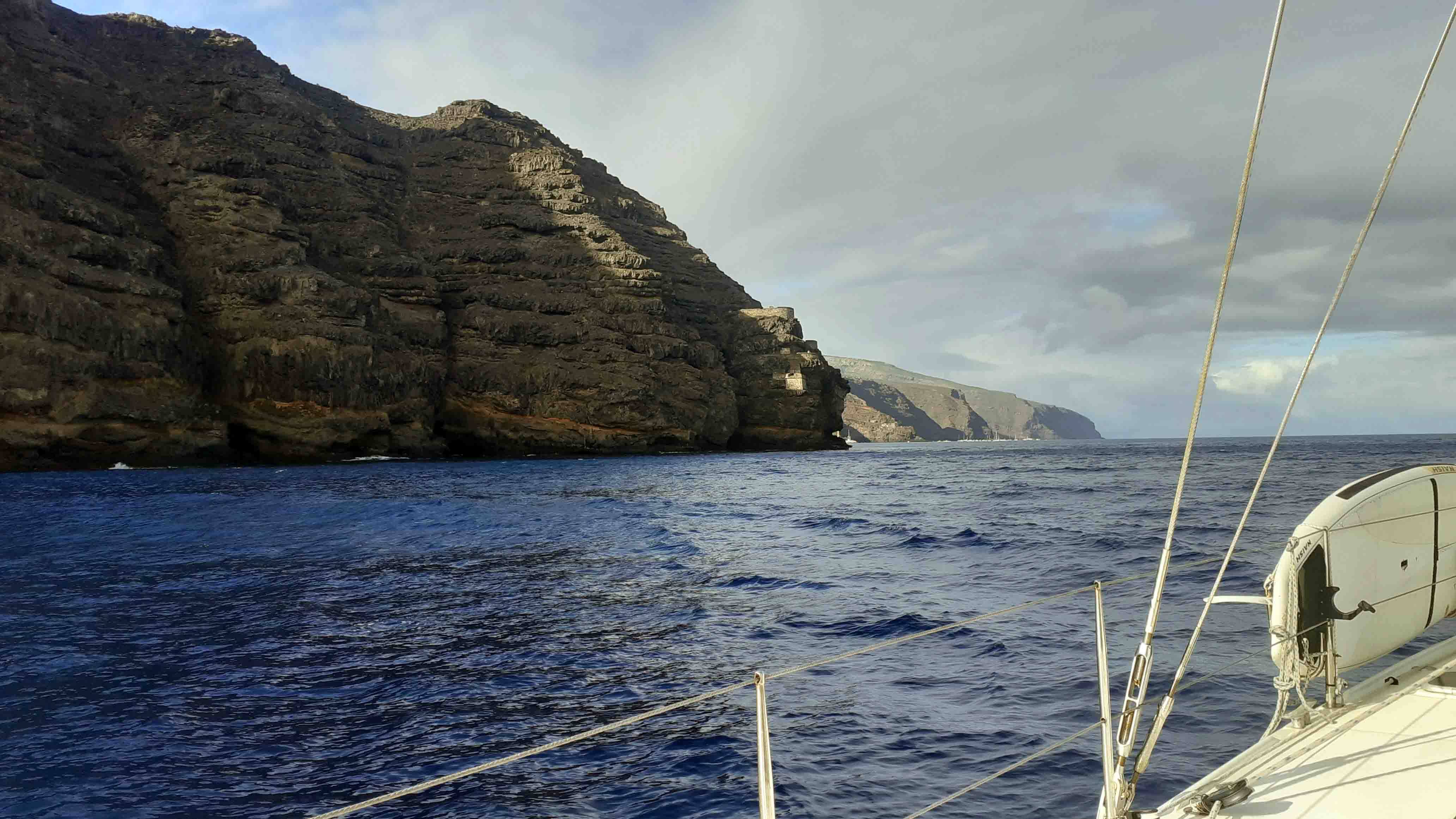
Approaching St. Helena


Tuesday, March 8, 2022

Namibia to St. Helena

Technology makes our life as ocean goers so much easier. Besides the auto-pilot ('Otto'), satellite communications for weather, GPS and radar, AIS is our superpower out here. It's like our eyes, but better. The Internet has all the details (look up Automated Identification System), but basically AIS uses VHF and GPS technology to let ships track each others' position anywhere on earth. Smaller fishing vessels in certain parts of the world often don't have AIS, so you still have to keep watch). Most of the time, ships will see us on AIS and avoid us without even a radio call. As a vessel under sail, we technically have the right of way, but bigger ships always win.

But sometimes ignorance can be bliss.

On our passage from Namibia to St. Helena, there was a huge tanker called 'Winning Kindness' that was drifting along as we passed it. We were too far away to see it but it showed up on AIS. We wondered what it was doing, but often ships will change their speed to get to their destination at the right time. Then later that evening, we saw the same ship on AIS again. This time it was going 12 knots and we were projected to be on a collision course. It didn't help that our boat speed was fluctuating a lot due to the flaky winds we have been getting, making it hard for other boats to predict our position. As we kept an eye on the boat's position for the next hour and a half, it occurred to me that it was like the start to a bad horror film. 'An unsuspecting family unwittingly sails past a tanker. Later, the same tanker is suddenly in front of them and heading straight for them.'

Well, of course nothing bad happened and the tanker passed a couple miles behind us. If we hadn't had AIS, we would never have even known the ship was there until we saw its lights as it got closer. After spending so much time making sure we would avoid hitting Winning Kindness, we later saw on AIS that it was drifting along at .3 knots again. Of course, even though the drama on AIS kept us in suspense for such a long time, without AIS it would have been much more disconcerting to see a huge tanker that close to us, especially at night.

Being in South Africa and Namibia reminded us that the Portuguese gave the world more than Peri Peri chicken. Vasco da Gama and Bartolomeu Dias, who were Portuguese explorers that landed in Africa in the 15th century, did their exploring without any of the information or technology we rely on. It puts what we're doing--with all the tools at our disposal--into perspective.

But almost nine days at sea is still nine days at sea. Overall, it was a pleasant-enough passage, but it was certainly not a set-it-and-forget-it kind of sail. The flaky wind required many course adjustments and sail changes. The seas kept much of the ride bumpy and banged the boat around. But we made bread (using Maeve--the 50-year old sourdough starter that Merel on Anjea gave us), fished (1 mahi mahi and 1 tuna) and played Euchre.

As always after a long passage, we were elated to see land. We were greeted by huge volcanic cliffs that plunge into the sea and a mooring field full of boats, including a few that we know. Having arrived on Tuesday morning, we have a couple days on the boat before our PCR tests on Thursday. It's just as well because it gives us a chance to rest and work on some of the projects we have accumulated. We can't do much about the dead start battery for the generator and starboard engine until we can get to land, but the top car for the mainsail needs a repair and the clothes we have been wearing for way too long need to be washed.

Monday, February 28, 2022

Namibia to St. Helena. Also, track us!


Matt mentioned the other day that when he had seen other cruisers' pictures of the Namib desert, he had no idea how cold it would be. I mean, it's the desert. It's supposed to be hot during the day, right?
 
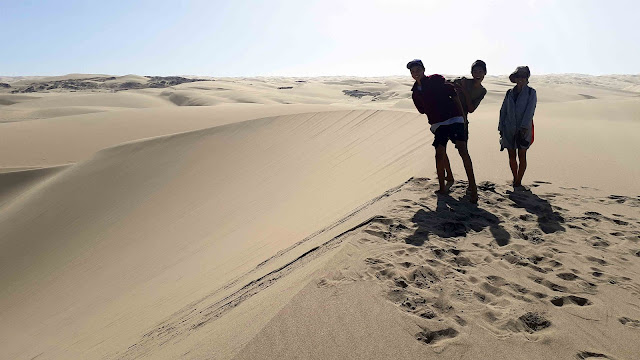
Perry surrounded by dunes at Hottentot

So why have we been bundled up with every layer we own during our sails through Namibia? It's the Benguela Current, which acts like an air conditioner for the entire coast of Namibia. The water temps hover around 55 F, and the air is about the same. Our sail from Luderitz to Hottentot Bay was cold, fast and a bit lumpy. There was a lot of fog, seals and dolphins too.

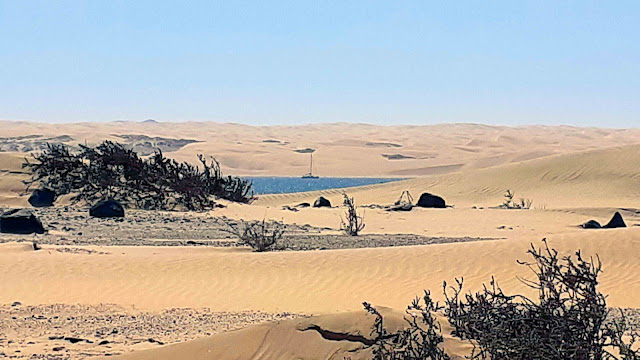
Hottentot Bay is a deserted desert with endless dunes, a few abandoned and semi-abandoned buildings, and a handful of lobster fishing boats. After an afternoon enduring howling winds, the next morning was relatively calm. We were able to launch the dinghy and spent a morning climbing some dunes and exploring the shore. Later, one of the lobster boats insisted that we take a huge (~15 kilo) bag of very small spiny lobster, which they delivered to us by having us throw a rope at them and tying the bag of lobsters to the end of the rope. There were way too many for us to eat and even though we appreciated the gift, we ended up letting over half of them go to keep growing. But some weren't going to make it. So we've been feasting on lobster for the last 3 consecutive meals (breakfast excluded, although we would have made lobster omelettes if we had been on our game).

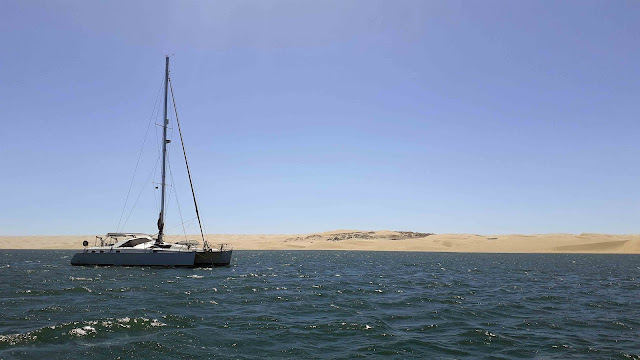
Perry in Hottentot Bay

The anchorage was comfortable enough for us, but the wind was screaming in the rigging and there was a bit of an onshore swell. Based on the conditions we decided to skip Spencer Bay, the next possible stop to the north, and make our way straight to Walvis Bay (pronounced something like "Vahlfish" by some of the locals). We sailed past Spencer Bay in the dark so we didn't see the resident penguin colony, but I could sure smell it.

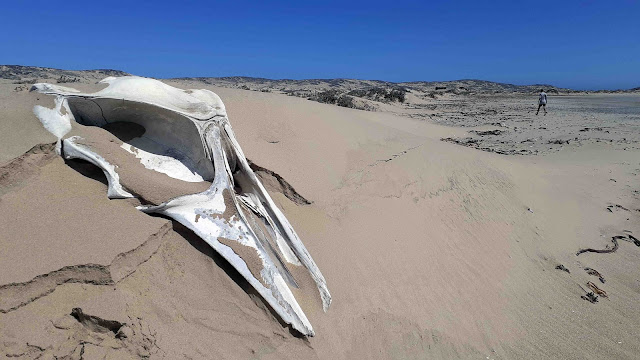
Whale skull at Hottentot
 

Besides wanting to visit Hottentot Bay, we came to Walvis Bay mostly because the forecast for the weekend showed very little wind down in Luderitz. Now mind you, leaving from either Luderitz or Walvis Bay to go to St. Helena, is about the same distance. So we basically sailed 261 nautical miles over two days and two nights to catch the wind and avoid motoring. We have apparently become true sailors, which is to say, a bit touched in the head.

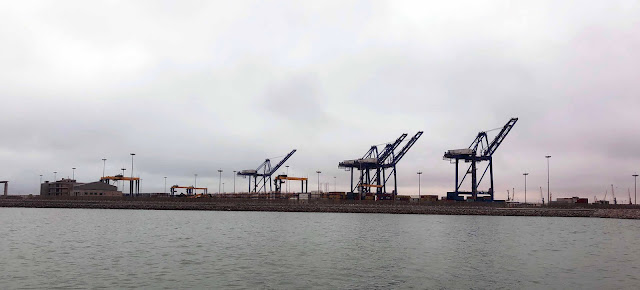
Namport Container Terminal in Walvis Bay

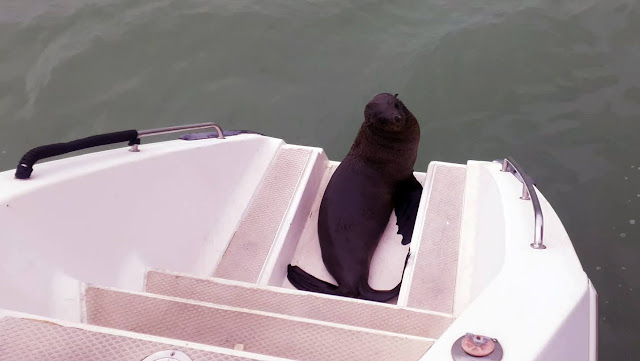
Today, Walvis Bay has a very distinctive and strong fish, sulphur and guano smell (apparently there is an algae bloom that is killing off some fish) and Perry is anchored next to a big dock with huge cranes and hundreds of shipping containers. We stretched our sailing-atrophied legs to walk to and around town, which is a couple miles from the Walvis Bay Yacht Club, near our anchorage. We got a bit spoiled being at the V&A and Luderitz, where the stores were very close to our boat. One of the kids (I won't say who) was at a 7/10 on the whine-o-meter. There are lots of seals in the harbor and several have already tried to take up residence on our transom.

Are you really going to make me move, dude?

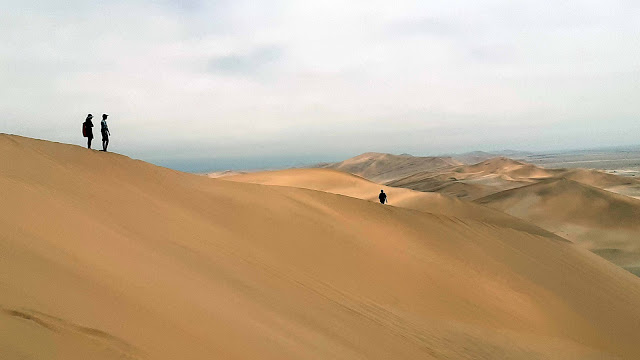
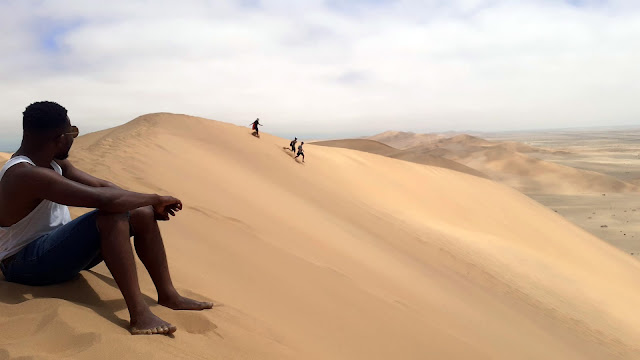
Dune 7, which, at 1,256 feet (383 meters), is the tallest dune in Namibia (the seventh tallest in the world), is the other reason we wanted to visit Walvis Bay. It's a short drive out of Walvis Bay and it beckoned us. We had to maintain our sordid history of mounting whatever high point exists in the area. Apparently, we also really like having sand in our teeth and every crevice of our bodies. This was also an acceptable form of exercise that did not involve parental cajoling or whining.


Dune 7 near Walvis Bay (not to be confused with Dune 7 in Sossuvlei)

After a couple days in Walvis Bay, we are headed to St. Helena. Because St. Helena is a very small country with limited resources, they can only do PCR tests (which are free) on Thursdays. So we have to time our trip to get there before Thursday, but not so soon that we are cooped up on the boat for more than a couple days. The journey should take about 10 days.

Racing down the dunes with our taxi driver, John, looking on. Spoiler: I lost.

Also, because Internet in St. Helena is a million dollars a megabyte or something crazy, we may not be updating the blog much until after we have finished crossing the Atlantic. While we are underway, you can track our progress here: https://forecast.predictwind.com/tracking/display/Perry/.

Sunday, February 20, 2022

Missing out or incredibly lucky?


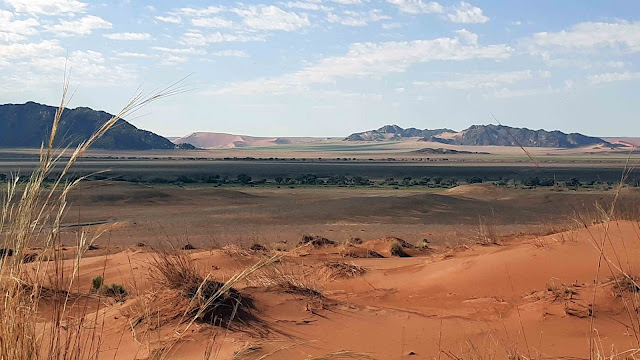
The desert in living color. Normally there is no green.

The top attraction in Namibia (competing with Etosha National Park) is arguably Sossusvlei, a salt and clay pan surrounded by high red dunes. I'll tell you straight away that we tried and failed to make it there. Still, we feel privileged rather than deprived.
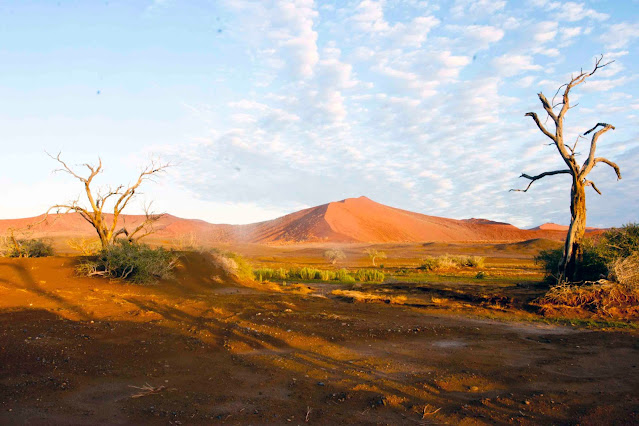
 
We climbed one of the smaller dunes--high enough for us in the heat

By all accounts, the dramatic dunes are a sight to behold. So we bit the bullet and shelled out the big money to rent a four-wheel drive Ford Ranger to navigate the sand and gravel roads that make up most of the six-plus-hour drive from Luderitz to Sesrium. We rationalized the extra cost as necessary because only four-wheel drive vehicles are allowed in the last four kilometers into Sossusvlei itself (if you don't want to depend on a paid shuttle service). With the local lodges running around $350 US per person per night, we opted for the cheaper, but still pricey campsite (over $80 US for camping--in your own tents--for the five of us). They came with power and personal showers and toilets, but it was still just camping. The one benefit of the campsite was that it was located inside of the park. That allowed us to get a head start as the park opens the inner gates that lead to Sossusvlei at 5:30 a.m. but doesn't open the main gate until 6:00 a.m.

We left Luderitz and had a stunning drive through some unreal landscapes that were made even more amazing due to the green hues and grasses covering the normally desolate red-brown of the desert. It's been an active summer here and the normally dry desert has been getting more rain than usual. After driving through a thunderstorm and a few sketchy bits of road, we made it to camp. We ended the day by watching the sun set over the dunes, enjoying a tasty oryx steak dinner, and having some drinks around the camp fire. Then off to bed as it was going to be another "up before the sunrise" outing.

OK, sorry to interrupt, but time for a bit of a sidebar rant. So we've been to a number of places where the "thing" was to get to a certain spot prior to sunrise in order to watch the sun rise over the mountain, sea, city scape or random goat or whatever. Of course, this usually means getting up at an uncivilized hour, stumbling around while trying to brush your teeth and making sure the underwear doesn't get put on backwards. Then it's off for a walk/drive/bumble, usually cold and certainly to the accompaniment of complaints from the children, to the pre-ordained perfect spot from which to watch the supposed miracle of the sun coming up. And almost invariably, when all is said and done, we've come to the conclusion that we could have just gotten up at close to a regular time and still experienced 99% of whatever it was. That extra 1% from seeing the very first ray of light is rarely worth the hassle of all that comes with it. 

And yet, somehow, we always forget these hard learned conclusions, and allow ourselves to be convinced that this time it really WILL be worth it to get up early and see the first light hit the dune, scrubby tree, or scraggly chicken. This time was no different.

So, the next morning, we got ourselves up in the dark to time our arrival at the dunes for sunrise and drove along the unlit gravel road, narrowly missing a jackal that darted towards the truck. As we approached the Tsauchab River, which is a normally dry collection of dust and stones, we were met with 3 stopped vehicles and this:
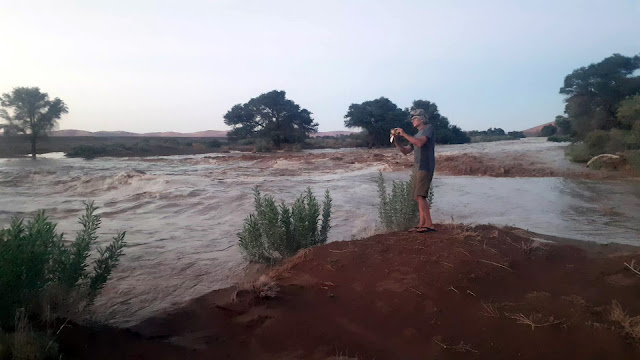
Our friend and car mate Dave (Anjea). Those are 2-foot standing waves in the Tsauchab River, which is normally a dry river bed.

This is a quote from the Sossusvlei travel site: "Sossusvlei literally translates to 'dead-end marsh', as it is the place where the dunes come together preventing the Tsauchab River to flow any further, some 60km east of the Atlantic Ocean. However, due to the dry conditions in the Namib Desert the river seldom flows this far and the pan remains bone-dry most years. During an exceptional rainy season the Tsauchab fills the pan, drawing visitors from all over the world to witness this spectacular site."
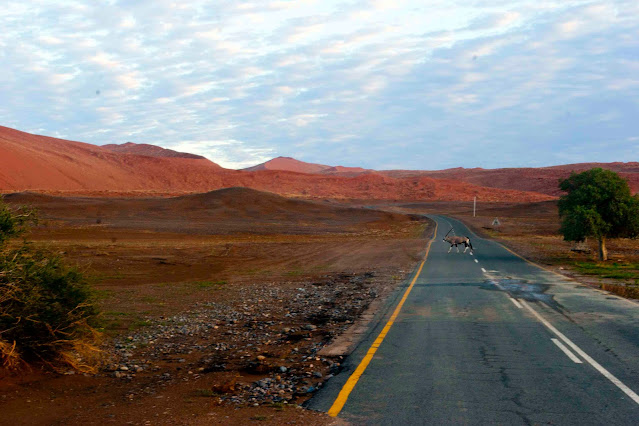
Why did the oryx cross the road?

We waited an hour for the river to subside enough to cross, but it never did. We went back to camp to have a cup of coffee and give the river a bit more time to go down. Our second try was also unsuccessful. So, instead of going to Sossusvlei, we climbed the unnamed dune that sits just before the river crossing. By that time, it was 9 a.m. and the sun and sand were already scorching. Matt and Conrad made it to the top, but Mark and I decided to head down because we were feeling light-headed and the sand burned our bare feet. We are (or were, anyway) used to heat, but the desert sun is no joke.
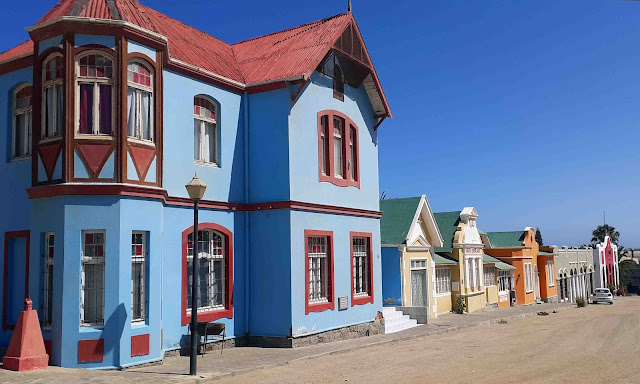
Luderitz, a German mining town, where Perry is moored.

By the time we left, the few vehicles that made it across to Sossusvlei before the river flooded were stranded and still waiting to come back to the Sesrium side. One intrepid man decided to try to wade into the river a few feet but quickly got out. It is ill-advised to wade in the waters. Besides the risk of being carried away, there can be snakes.
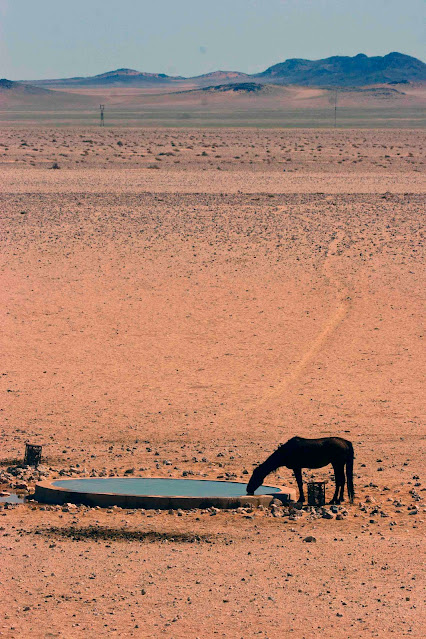
A wild desert horse


We have had many Namibians tell us how lucky we were to see the desert in bloom and how rare it was for there to be water in the river. Local tourism was up as Namibians flocked to the desert to witness the unusual scene.

We ran out of time to wait for the river and needed to start the 6 hour journey back to Luderitz. We planned our route back and got about three miles out of Sesrium when we encountered another flooded river crossing blocking our way. After chatting with a local car that had been waiting for three hours to cross, we decided the only option was to wait for the water to go down and to head back to Sesrium and have some lunch. The prospect of not getting out and having to spend another night at the campsite was a real possibility. Luckily, a ranger at the restaurant told us of another crossing point where traffic had just recently been able to get through, so we headed that way after lunch. We made it across, after a few tense moments driving through the flowing water.

By the way, Matt later ran into the couple that was waiting for three hours (they have a house in Luderitz) and they never did get through. The spent another night in Sesrium.

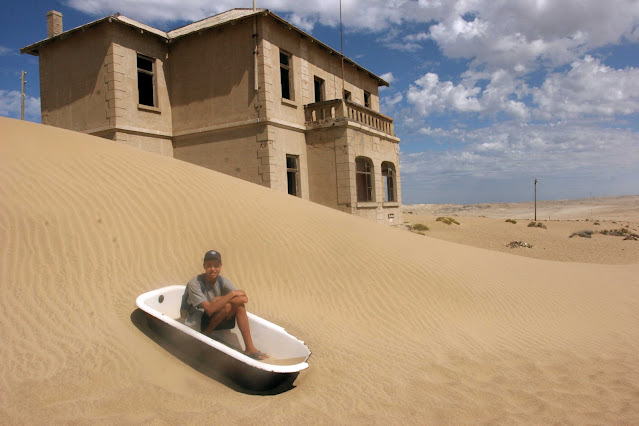
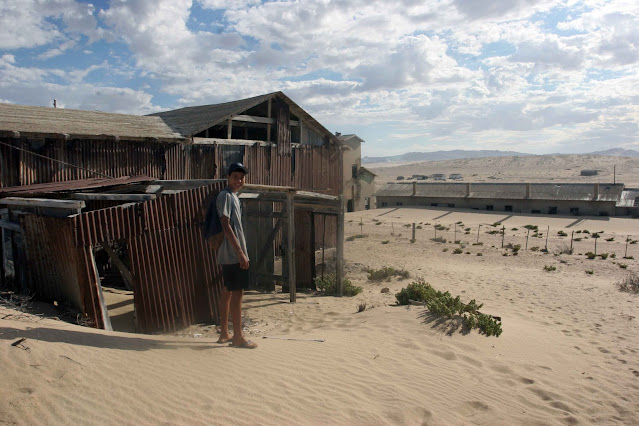
Kolmanskop, the German diamond mining ghost town

Our trip back was punctuated with heavy rain and a tire change. We're still not sure what we hit, but it did a number on our tire and we later ended up having to buy a new one. We were happy to make it back to Luderitz before dark. Despite never making it to Sossusvlei, we were witness to rare and spectacular scenery. We don't know what we missed, but we know that what we saw was beautiful.
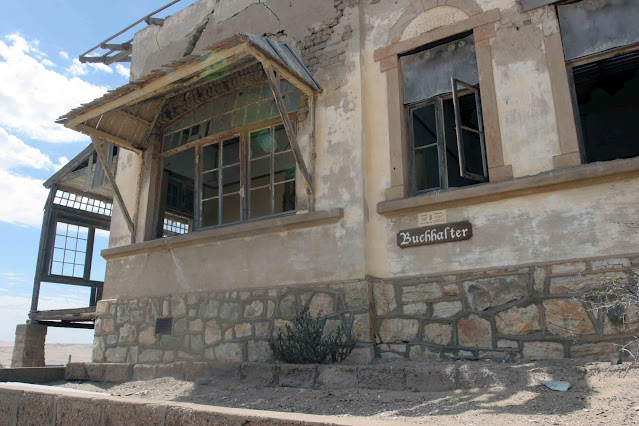
Though abandoned for many decades, some of the Kolmanskop buildings look better than newer buildings we have seen in various parts of the world
 

We quite like Luderitz and have enjoyed the best Eisbein we have had yet. The German influences in the architecture and food give the town a European feel (if you keep a narrow focus and ignore the desert just down the block). We spent a morning in Kolmanskop, the abandoned diamond mining town that once boasted the largest production of jewelry-grade diamonds and the highest per capita income in the world. All the building material, including sand (in a desert, mind you), was brought in from Germany.
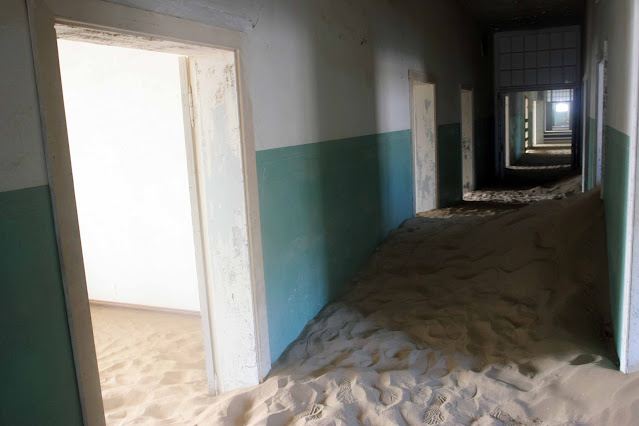


A hallway in the krankenhaus (hospital)

We also spent a day driving the peninsula around Luderitz, which still has diamond mining and processing operations. There are many lovely bays and rocky hills, with seals, penguins, and flamingos.
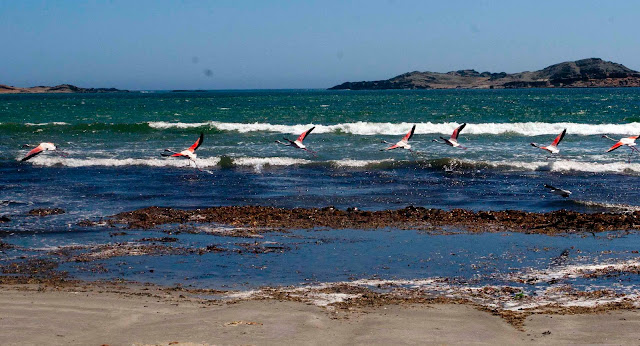
The flamingos are not as pink as some but have a lovely color when they fly.
 

On the sailing front, our trip from Cape Town to Namibia was mostly uneventful, if a bit slow due to a lull in the wind. The whisker pole failed again, which Matt has already fixed (hopefully more robustly this time). 

The bigger issue on the passage was that our satellite phone connection was nearly unusable, making it essentially impossible to download weather data and emails. With our provider unable/unwilling to help us fix the problem, we were facing an Atlantic crossing without good weather information or reliable communication. 

Fortunately, our friends Andrew and Leslie on Sonrisa, who were still in Cape Town, found and bought an Iridium Go! for us and got it to our friends Paul and Chris on Georgia before they left Cape Town for Luderitz--all while we were mostly out of cell phone range on our Sossusvlei trip. A few days later, Georgia arrived in Luderitz after a fast and sporty passage and we now have our new Go! in hand. Dave on Anjea has been kind enough to sell us the SIM card we need. We have amazing friends and this was one of the times when we have been blessed with good timing. Once we get the Go! working, we can start moving north towards Walvis Bay. The Atlantic crossing gets closer and closer.

Monday, January 31, 2022

We love Cape Town! But should we?


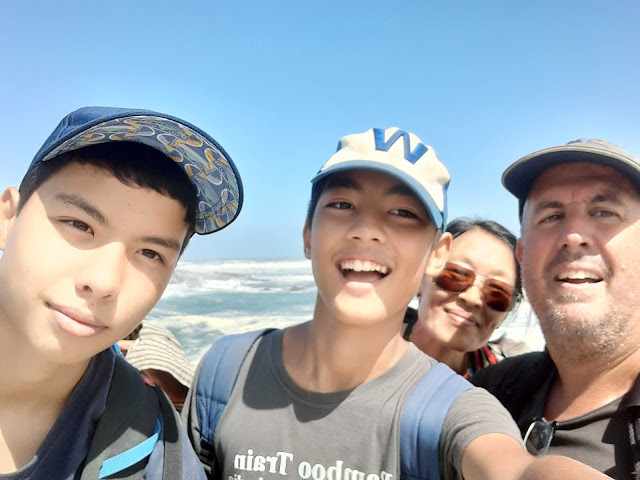
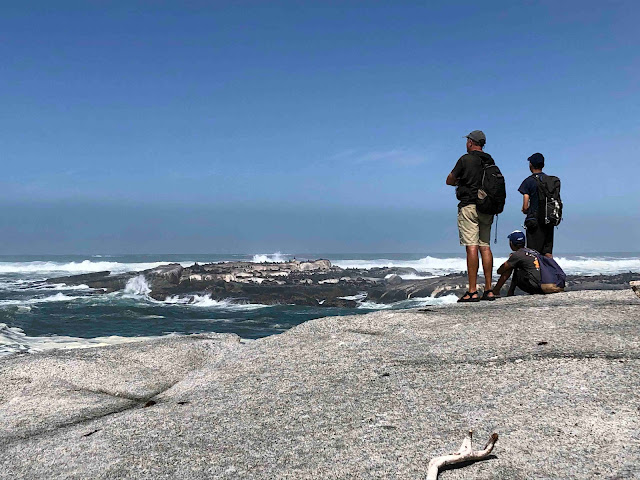
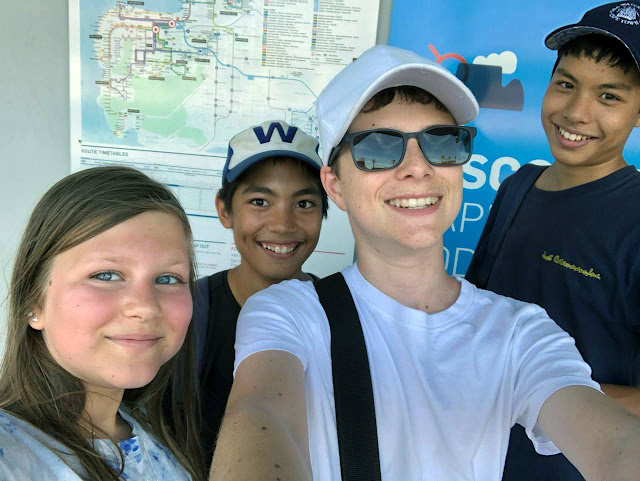
This is not a great 'ussie' (plural of selfie), but we always forget to take pictures of ourselves so we publish the picture we have, not the one we want. Hout Bay.
 

We haven't met one cruiser who doesn't like Cape Town. This is a rarity because we're all different and not everyone likes the same things. The folks that love the remote islands with villagers that come to trade don't always like bars and restaurants that mark the more populated areas and vice versa.

 
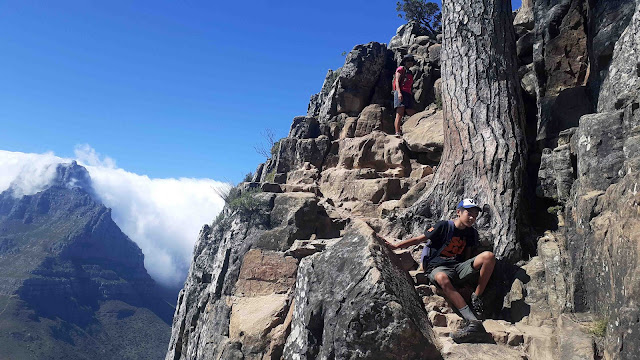
Climbing Lion's Head. Table Mountain in the background.

Cape Town has it all. The ocean and mountains provide a stunning backdrop to the well-planned city and surrounds. The restaurants are affordable and top-notch. It's easy to drink too much of the locally produced wines, with easily accessible vineyards and reasonably priced bottles. Our cruising friends back home can't needle Matt about being stuck with bad beer (you know who you are). The people are warm and friendly.

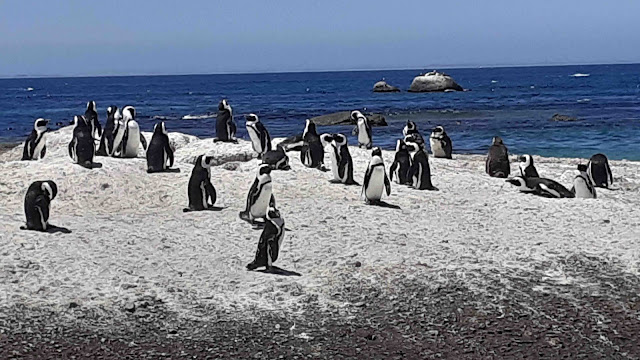
Seaforth Beach penguin colony
 

It's not perfect, of course. The V&A is sheltered from the many homeless and poor, but they are just outside--in make-shift shelters and holding up signs in traffic and they're in the 'Townships'. The area is not crime-free, though it's hard to gauge how it compares to, say, Chicago. Even just outside the V&A there are many business who will only accept electronic payments to avoid having cash on hand and most residences and business complexes are surrounded by secure fences with barbed and/or electrified wire.


And as much as I have enjoyed our time here, it doesn't really feel like we are cruising. Cape Town has provided us a cocoon of ease and luxury after years of being out of our comfort zone in some way. We have had Perry parked in a marina in single place, don't have to put our dinghy up and down, can speak English (the lingua Franca here), are able to walk to grocery stores that stock any food we want, and have a plethora of entertainment options (restaurants, parks, shopping, hiking, vineyards). Conrad has been able to make good use of the shore power and Internet here.

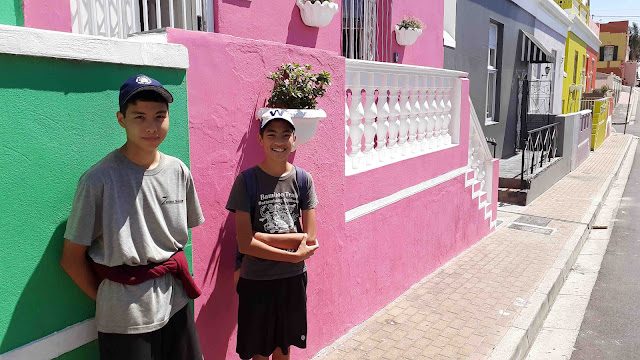
The colorful houses of Bo Kaap (previously The Malay Quarter)
 

Dungeons in Hout Bay can be a world-class surf break when the conditions are right (usually during the Winter months).

We have met several boats who are just starting their cruising adventures. The Robertson and Caine factory and several other boat builders are here and the docks near our boat are lined with shiny new cats whose owners or crew are busy preparing to leave. Their excitement and energy is a bit infectious. Living in this world-class, yet affordable-to-us city is in some ways a dream come true, but the urge to push on and to be closer to our families is bubbling to the surface. Weather permitting, we will leave for Namibia in about a week. After Namibia, we plan sail to St. Helena, Ascension Island, and Trinidad (to fix the paint marred by the concrete wall in Galle Harbour). There's a lot of ocean to cover between here and there.

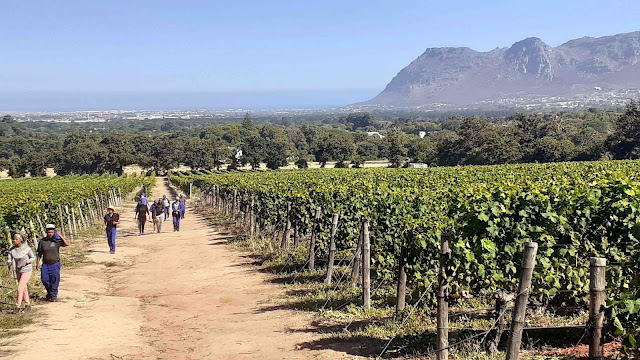
Workers leaving the vineyards at Groot Constantia

 
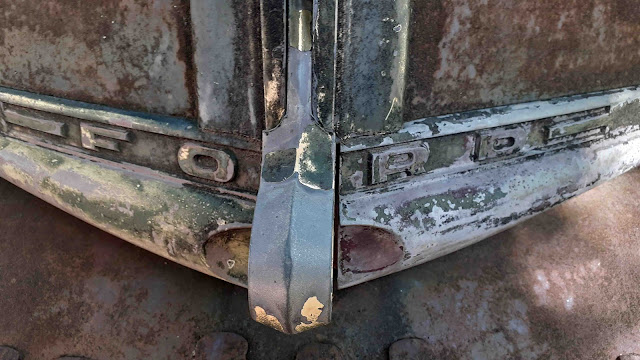
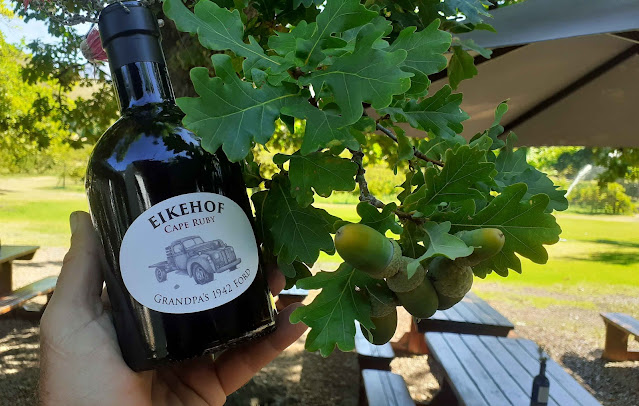
The old Ford in question (see the bottle of Port pictured below)


Eikehof Wynes (Eike is Dutch for oak)

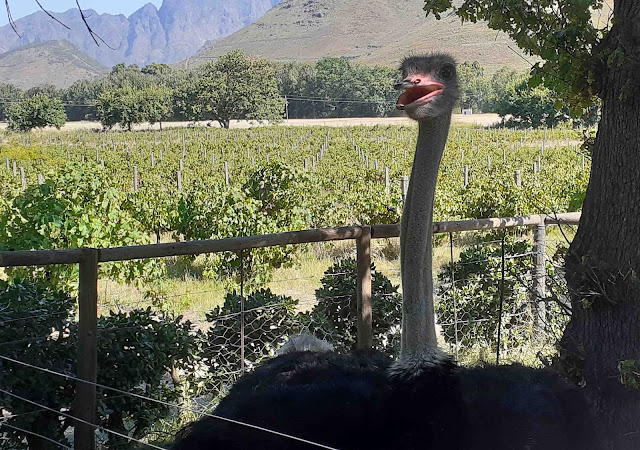
An Eikehof Wynes ostrich

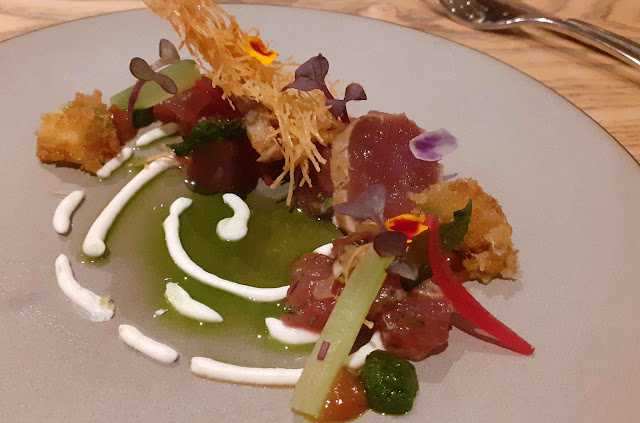
Part of the Chef's tasting menu at Protégé Restaurant

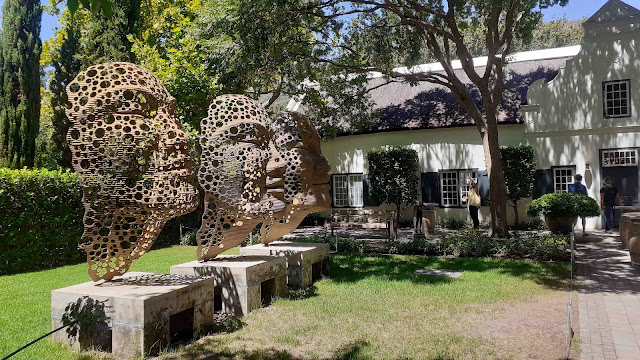
Grand Provence Heritage Wine Estate

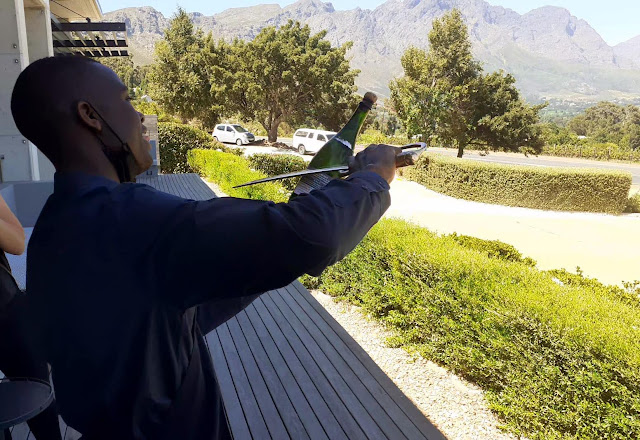
'Sabrage' demonstration at Haute Cabriere. Another use for our machete.
 

Friday, December 31, 2021

Cape Town for Christmas


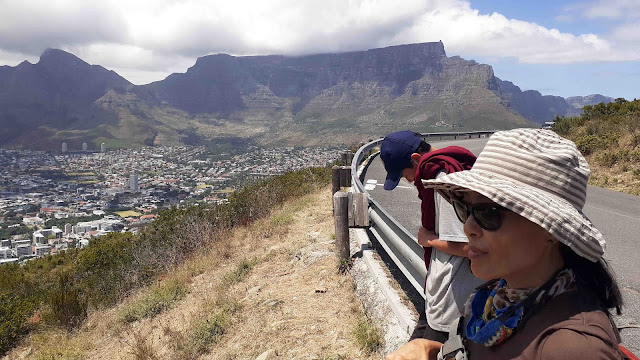
The top of Signal Hill with Table Mountain in the background

 'Cape Town for Christmas' has been our mantra--repeated amongst almost every cruiser headed this way--for so long that it was hard to believe that we were actually here (in time for Christmas, with a day to spare).

Getting excited about the one harbor seal in Knysna seems so quaint now.

Like many hard-won goals, the journey was just as significant as the end-result. Actually, there was hardly any evidence of Christmas at all here in Cape Town besides a smallish tree and the odd decoration. Even Muslim Malaysia was more 'Christmas-y', with loads of decorations and Christmas music.

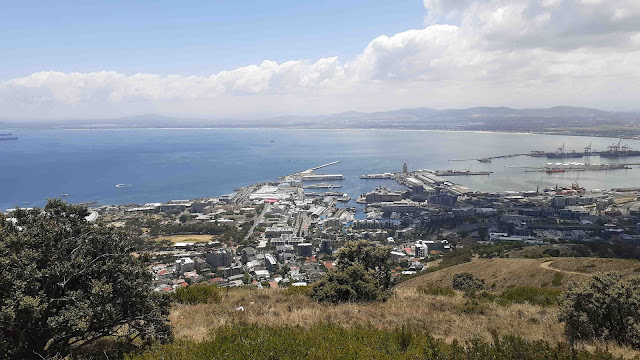
View from Signal Hill

There was holiday socializing aplenty: we had eggnog and watched How the Grinch Stole Christmas on Perry with Sonrisa's projector, enjoyed a happy-hour get together with all the other cruisers with oysters provided by Ohana and Dafne 2, and Sonrisa hosted an upscale Christmas morning dock breakfast. Unfortunately, on Christmas morning itself, Matt was laid out with a stomach bug but we had a pleasant, low-key day.

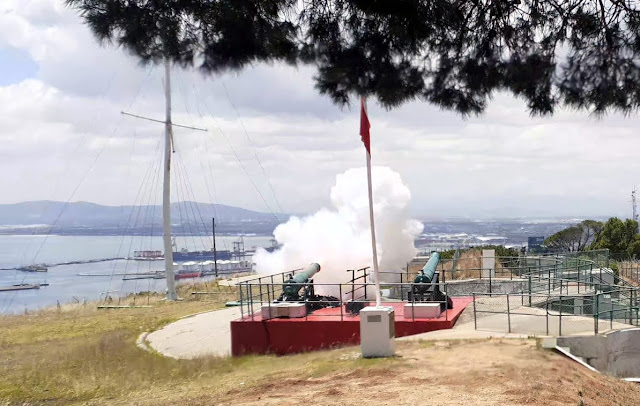
The cannon fires every day at noon.  Yes, it's loud.

The journey to Cape Town from Knysna marked the end of our stint in the Indian Ocean. We have officially ranked the Indian Ocean as the third favorite of the three Oceans we have sailed in due to its usual combination of large and confused seas (we might even rank it 4th, just on principle alone). Ironically, the worst part of our leg from Knysna to Cape Town was after we had crossed the invisible line into the Atlantic Ocean. With Cape Town almost in view and most of the passage complete, I was starting to feel pretty good about having 'completed' our journey past the southernmost point of the continent. The wind had filled in nicely and we were sailing along at a nice clip after having been so light that we had to motor for a good part of the prior evening.

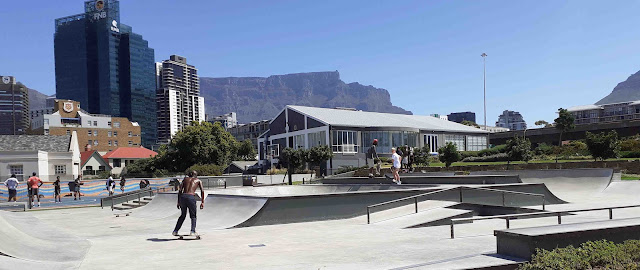
Skate park with Table Mountain as a backdrop

But as we passed Hout Bay, the winds started to pick up and kept getting progressively stronger. When Table Mountain came into view, we could see the 'tablecloth' (the sheath of clouds that sometimes blankets the mountain) being pushed down its side by katabatic winds. After breaking our mainsail batten recently too many times with strong and unpredictable winds, we decided to douse the already triple-reefed sails and motor in. 
For the next hour, Perry was tossed around by confused seas surpassing our trip from Curacao to Cartagena. There were sustained winds of 40 knots with at least one 57-knot gust. We broke dishes that have lived unscathed on Perry for nine years because of the weird way the waves jerked the boat around. Matt and Conrad were soaked by waves as they stood in the cockpit, which is unusual on Perry. This last battering by the local ocean was mostly just uncomfortable rather than dangerous but we were relieved as we entered the calm waters of the port just before sundown.

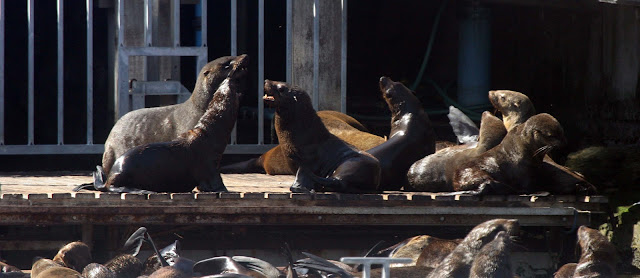
Mark and Conrad finally together again with these guys
 

As it turned out, we had bad timing, bad luck, or both. Boats that came into Cape Town earlier in the afternoon and the following morning had completely calm seas. On our approach, we were lucky enough to see a penguin and breaching humpbacks in the midst of dozens of seals and dolphins.

We have been enjoying the V&A Waterfront, which has the feel of Disneyland without the rides (though there is the giant, slow-moving Ferris wheel). Shopping isn't our thing, but it is a luxury to be within walking distance of a grocery store that has pretty much everything. We have also taken advantage of a few of the many restaurants, rationalizing that we went so long without eating out that we can afford to splurge a bit. This is the kind of thinking of course that will drain our bank account and give me ulcers. But the delicacies beckon.

We are ticking boat projects from our list and at some point will rent a car to play tourist. This is wine country (and our dollar goes a long way in South Africa). Wine tasting is almost a sport here and the vineyards resemble Napa Valley. We also want to go to the top of Table Mountain,   see penguins (the last ones we saw--besides the guy en route--were in the Galapagos), and a hundred other things. One thing we are not planning to do is swim in the 56-degree Fahrenheit water.*

*Matt and Conrad considered doing a Great White shark cage dive, but killer whales have mostly chased them away from the area.